
CORKY
Corky the Survivor
Corky is the longest surviving captive orca whale in the world – 55 years in a concrete tank. She was captured along with other members of her A5 pod family in 1969 in Pender Harbour, British Columbia. The A5 pod, part of the northern resident orcas, was devastated, as 13 members were taken into captivity in two captures in 1968-69. In addition, 63 orcas of the northern and southern resident orcas of the Pacific Northwest were captured in a 13 year period in the 1960-70’s. The southern residents of the Puget Sound area have still not recovered, are down to only 73 whales, and are listed as highly endangered. The northern residents of British Columbia have recovered well, numbering over 370 whales, and Corky’s A5 pod has grown to 16 whales in the wild.
All 12 of Corky’s other captured family members died long ago in captivity. Sonny, one of the fishermen who was on the capture team, now has serious regrets about the capture, saying, “If I had to do it over, I wouldn’t do it.”


4 year old Corky, possibly with her mother during the capture
Corky was only 4 years old when she was taken from her mother, and transported to Marineland in Los Angeles and trained to perform Killer Whale shows. Two others of her pod that were taken with her to Marineland soon died, leaving her alone with Orky, a male cousin she then mated with. Corky delivered the first ever live birth of an orca in captivity, but the calf failed to nurse and died at 11 days old. Corky had six more babies, some stillborn, and the longest lived was only for 46 days. Corky stopped ovulating at 21 years. In the wild, female orcas would have about 25 years of reproductive life.
In 1987, Corky was moved with Orky to SeaWorld San Diego, where Orky fathered two calves with Icelandic orcas, but he died after 18 months there. Corky was now without her natural family. She became the main performer of the “Shamu” show.
More tragedy hit when tension developed between Corky and one of the Icelandic females Kandu, who had her baby Orkid with her. Kandu rammed Corky during a show. Kandu broke her jaw, with blood spurting out, and died in front of the audience. Such aggression never happens in the wild; it was clearly a result of the stress of confinement in un-natural groupings in captivity. In a twist of fate, Corky became Orkid’s surrogate mother.
Corky is a large and powerful female orca, but she is known to be very sweet and gentle. Because of her nature, new trainers are often started working with Corky first.
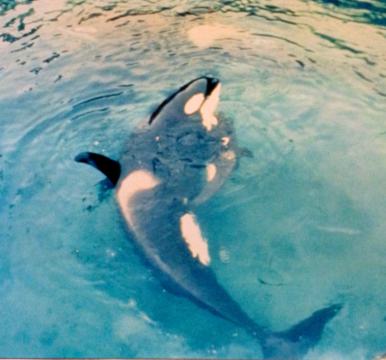
Corky with Baby
Corky with her baby at Marineland

Corky’s niece Midsummer with new baby Ne’nakw. Photo by Jared Towers

Part of Corky’s A5 pod. Photo credit Megan Hockin Bennett
Corky’s original family, the A5 pod of Northern Resident killer whales, remains active and has grown to 16 members. Her sister A43 “Ripple,” brother A60 “Fife,” and niece A69 “Midsummer,” who gave birth to A126 Ne’nakw in 2021, are regularly seen in nearby waters, including Blackfish Sound and quite often near the entrance of Double Bay.
If Corky were to reside in a coastal sanctuary within her native range, acoustic contact with her family could be possible. Northern Resident orcas maintain stable dialects over generations, and early vocal learning is known to persist. While it is uncertain how much of her original dialect Corky retains after decades in captivity, the potential for recognition remains a topic of scientific interest.
Now at 60 years old, Corky is older than the average lifespan of wild female orcas, though some live up to 80 to 100 years. Corky remains active and still performing at SeaWorld, but after 55 years in captivity, release to the wild is not considered feasible. Providing Corky the very best quality of life is our goal. We firmly believe that is by retirement to the much larger and deeper natural seawater environment of the Double Bay Sanctuary with continued medical care and feeding by a team of trainers, veterinarians, and support crew. There, Corky can swim faster, dive deeper, use her sonar and echolocation, feel the tides change, explore the rocks, sand and kelp, and interact with the fish, crabs, birds and other sea-life that inhabit Double Bay. And there is room for a companion orca so Corky does not have to be alone. Corky deserves this chance to return home and live a healthy and long life in her home waters.


